
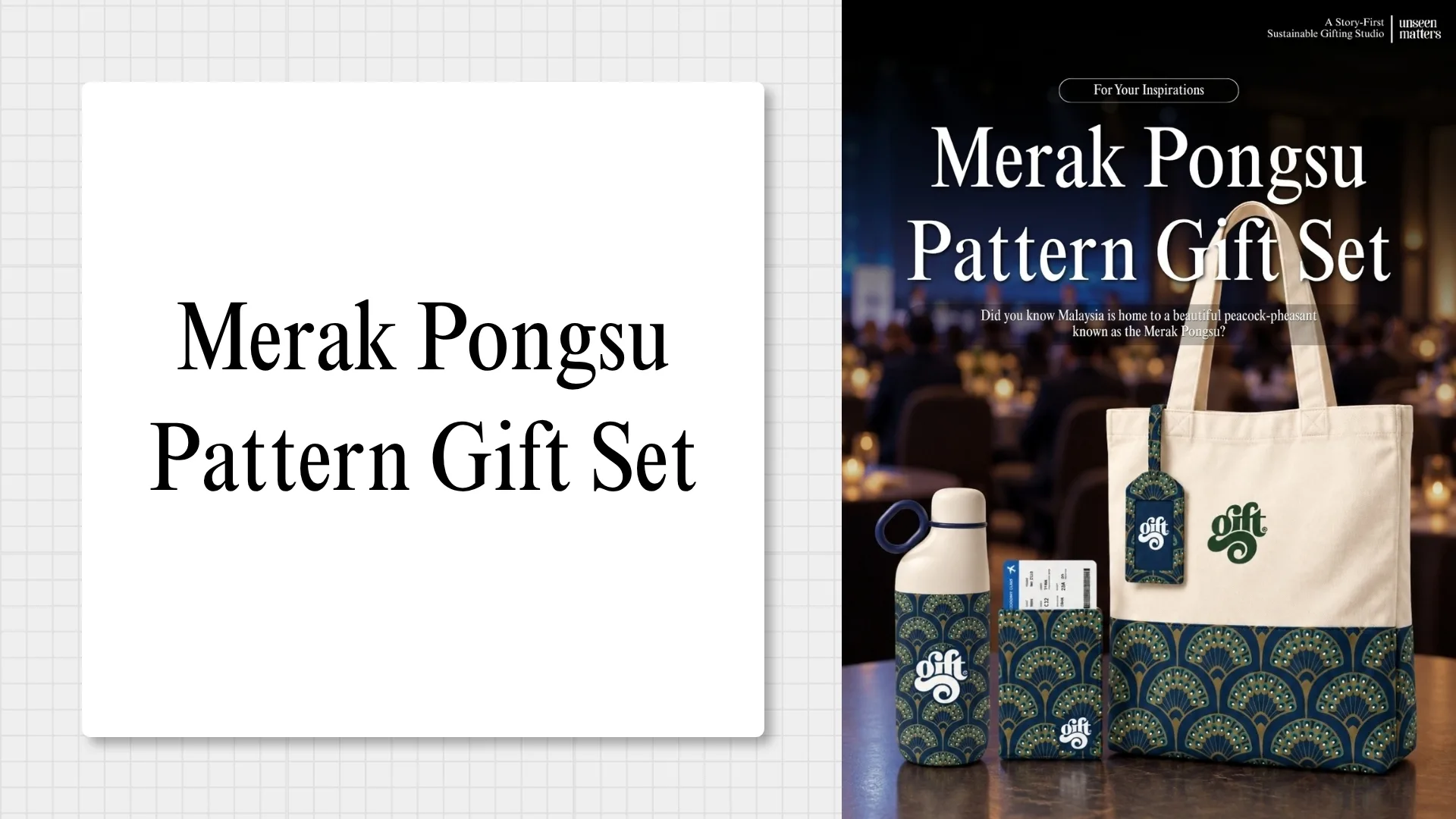
A corporate gift can carry more than a company logo — it can introduce someone to a story they haven’t heard before. The Unseen Matters Merak Pongsu Pattern Gift Set takes its inspiration from a bird found in Peninsular Malaysia and turns details of its plumage into a contemporary motif for gifting.
At first glance, the design is a repeating pattern of fan-like shapes in deep blue, turquoise and gold. Look closer, and the small eye-shaped details begin to explain its name. The motif draws from the Merak Pongsu, or Malay peacock-pheasant, whose scientific name is Polyplectron malacense — Malaysia’s biodiversity database records the species under that local name.
The concept brings that pattern across a coordinated gift set, including a tote bag, bottle, box and tag shown in the carousel. It gives organisations a way to present something visually cohesive while sharing a distinctly Malaysian source of inspiration.
Where Does the Merak Pongsu Pattern Gift Set Design Come From?
The gift set’s pattern is drawn from the Merak Pongsu, a Malaysian forest bird, turning its feather markings into a coordinated motif across a full set.
Corporate gifting often begins with a practical question — what should we give our guests, clients or team? The more interesting question comes next: what should the gift say? For this set, the answer begins in Malaysia’s natural world. The design takes a bird that many recipients may not recognise by name and makes its most striking visual details the centre of the gift. A pattern invites someone to ask where it came from, and that question gives the organisation a chance to share the story behind the design.
This makes the set suitable for an event that wants to celebrate local identity without relying on a familiar landmark or flag motif. The Malaysian connection here is specific — the pattern refers to a real, named species, while its restrained colour palette keeps the products feeling contemporary rather than folkloric.
The idea also gives the set a clear internal logic. Each item plays a different role, but the repeated motif ties them together — a recipient encounters the story on the outer packaging, sees it again on the tote, and may go on using an individual item long after the event.
What Is a Merak Pongsu?
The Merak Pongsu, or Malay peacock-pheasant, is a forest bird native to the Malay Peninsula, known for its eye-like feather markings.
Despite its name, it’s different from the large peacock most people picture when they hear “merak” — it’s a smaller forest bird, and Tourism Malaysia describes the Malay peacock-pheasant as a medium-sized species endemic to the Malay Peninsula. Its distinguishing feature is the eye-like markings across its feathers.
Those markings are the design’s starting point. When the bird displays its plumage, the repeated eyespots and spread of feathers create shapes that read as fans. The carousel places an image of the bird beside the finished motif so the connection is visible rather than assumed.
The design is an interpretation, not a literal illustration of the bird on every product — a distinction worth keeping clear. A recognisable feature of the Merak Pongsu becomes a pattern that can work across objects of very different sizes and materials. Someone doesn’t need to identify the species immediately to appreciate the design, but learning its origin adds a second layer of meaning to something they might otherwise take at face value.
How Was the Bird’s Plumage Turned Into a Pattern?
The pattern takes the bird’s fan-shaped display and eyespots and simplifies them into repeating shapes in deep blue, turquoise and gold.
Turning an animal into a gift design involves real choices. A detailed photograph might work on a poster, but it doesn’t always translate onto a bottle, a small tag or a fabric panel. A simplified motif gives more flexibility across those surfaces.
Curved outlines suggest the bird’s spread feathers. Small turquoise details echo the eye-like markings. Repeating the shapes creates a rhythm that can cover a large surface or appear as a smaller accent, depending on the item. Deep blue gives the pattern a calm background, gold-toned lines define the fan shapes, and the brighter turquoise draws the eye to the eyespots specifically. Together, the palette creates something expressive without needing a realistic bird illustration anywhere on the set.
That flexibility is what makes the set feel coordinated rather than assembled. The motif can appear prominently on one product and more sparingly on another, and a recipient still recognises the connection between the pieces because the shapes and colours stay consistent throughout.
What Is Shown in the Merak Pongsu Gift Set?
The carousel shows four coordinated pieces: a tote bag, a bottle, a box and a gift tag, each carrying the pattern differently.
Tote bag — a light-coloured tote carries the pattern across its lower section, leaving an open area above for branding.
Bottle — the motif wraps around the bottle’s curved body, showing how the pattern adapts beyond a flat panel.
Box — a patterned box creates a strong visual moment before the contents are opened.
Tag — a matching gift tag carries a smaller version of the design and has room for a short story line.
These images show how the concept works as a set; the exact product specification, materials and contents should be confirmed for an actual order, particularly where an organisation has requirements around bottle type, tote fabric, packaging or branding method.
The value of the concept lies in its shared design language — rather than picking unrelated objects and placing the same logo on each, the set starts with a motif and works out how it should appear across the full presentation.
Why Does the Packaging Carry the Pattern Too?
The box, tote and tag carry the pattern so the presentation feels like a continuation of the same story, not a separate wrapper around it.
A gift starts communicating before the recipient reaches its contents. The box, bag or tag may be the first thing they see, particularly when gifts are arranged at an event. If those elements look connected to what’s inside, opening the set feels continuous rather than like unwrapping a generic box around an unrelated item.
The Merak Pongsu motif suits that journey because it works both as a large repeating pattern and as a small detail. On a box, it establishes the visual theme. On a tag, it hints at what’s inside. On the individual products, it becomes part of what the recipient may go on using.
Presentation should be planned around how recipients will actually receive the set — handed over at registration, placed at their seats, or delivered after the event. Each situation calls for a different way to arrange and carry the items, and packaging decisions should follow from that, alongside how many sets are needed and what each one should contain.
How Is a Company Logo Added Without Overpowering the Pattern?
Branding sits in the tote’s open area and on individual products, while the Merak Pongsu motif stays the dominant visual element across the set.
A company may want its logo on every part of a gift set — understandable, especially for a conference or campaign. But the strongest result usually comes from deciding where the brand needs to be most visible and where the design needs room to breathe. In the carousel, branding appears against the light area of the tote and on individual products, while the motif remains the set’s main visual element.
That balance gives the recipient a clear connection to the organisation while preserving the pattern’s story. A logo placed with care is often easier to recognise than one repeated inside a busy composition — the nature-inspired pattern gives the gift its character, and the company identity explains who chose to share it.
For an actual project, the right balance depends on the client’s artwork, event theme and intended recipients. Some organisations prefer a small logo and a short story card; others need an event mark to appear more prominently. Those choices are best made using the final products and print areas as a guide, not decided in the abstract.
Why Does This Gift Set Start a Conversation?
The pattern’s fan shapes and eyespots invite a question — what do they represent — and answering it introduces the Merak Pongsu and its story.
That exchange doesn’t need a long presentation. A short message on a tag or accompanying card can identify the bird and describe the connection between its eyespots and the motif. Guests who want to know more can follow the story; others can simply enjoy the pattern without needing the explanation.
This is where the set becomes more personal than a standard assortment of branded products. The items offer practical or decorative value on their own, while the shared design gives people something to talk about — the story is the reason the set looks the way it does, not decoration added after the fact.
For guests from outside Malaysia, the local reference can be especially engaging, offering a small introduction to the country’s biodiversity through an object they take home. For Malaysian recipients, it may draw attention to a bird whose name they’ve heard less often than its more famous wildlife neighbours.
Where Could This Gift Set Fit?
The set suits conferences, partner appreciation events, employee celebrations and any programme that wants to highlight a Malaysian theme.
An organisation welcoming international delegates might use the story to introduce a local species. A company marking a milestone in Malaysia might choose it because the design ties the gift to place. A team organising a nature-themed event could use the motif as part of a wider visual identity for the occasion.
The right choice still depends on the audience. A tote suits guests who need something to carry during an event. A bottle suits a workplace gifting programme. Packaging matters most when the set will be presented formally rather than handed over casually. The contents should be chosen for the people receiving them, not only because the pieces look good together in a photograph — the motif provides the common thread, but the product mix still needs to fit how the recipients will actually use it.
What Does a Story-Led Gift Set Need for a KL Conference Timeline?
A story-led set like this needs extra lead time for artwork review and pattern approval before quantities and delivery can be locked in.
Planners sourcing an event gift in Kuala Lumpur are usually working backwards from a fixed date, and a patterned, story-driven set has one extra step that a plain branded item doesn’t: the motif, its placement, and each product’s print or application method all need sign-off before production starts. That review stage is worth building into the timeline early, rather than treated as a formality at the end.
Beyond that, the same event variables apply as any other gift decision — how many recipients, whether speakers or VIPs get a different version of the set, and where the handover happens (registration desk, seats, or after the event). A set intended for a formal presentation moment may warrant a different arrangement of tote, box and tag than one simply collected in passing.
Sharing the delivery deadline at the same time as the recipient count gives the gifting team the clearest picture of what the artwork review and production schedule actually need to accommodate.
Can This Design Support an ESG or Sustainability Claim?
The biodiversity story explains the design’s inspiration, not the environmental performance of the finished materials — those are separate questions with separate answers.
A Malaysian nature story may fit an organisation’s broader interest in ESG, but the story alone doesn’t establish a product’s environmental performance. The Merak Pongsu pattern celebrates biodiversity through design; specific claims about materials, manufacturing, or measurable impact depend on the products actually selected for a given order, not on the motif itself.
It’s accurate to say the pattern was inspired by the bird’s plumage. It’s also useful to explain the intended function of each item in the set. But claims about recycled content, responsible sourcing, or environmental benefit need to be checked against the final specifications of that particular order, not assumed from the design story.
If your team needs an ESG-aligned gift and requires documentation to support that internally, say so in the initial enquiry — name the materials you prefer and what your organisation needs verified. A gift set is strongest when its story and its product details are both clear: the biodiversity inspiration sparks curiosity, and accurate specifications let the organisation stand behind what it actually gives.
How Should the Merak Pongsu’s Story Be Told Accurately?
Describe the pattern as inspired by the bird’s plumage, not as a literal depiction, and use its correct scientific and local names.
Using wildlife as design inspiration is a chance to help people notice the natural world, and that calls for some care in how the story gets told. The Merak Pongsu should be identified correctly, and the pattern described as inspired by its plumage rather than presented as an exact depiction of the bird.
The scientific name, Polyplectron malacense, gives an interested recipient a way to look further into the species. The local name gives the design its immediate connection to Malaysia. Including both makes the story accessible to different audiences without turning a gift tag into a wildlife article.
A brief explanation can focus on what recipients can actually see — the fan-like feather shapes and the eyespot details — and let that invite a broader curiosity about the species and its forest habitat from there. The set introduces a real source of inspiration without asking the product to double as a conservation campaign; any wider commitments or partnerships should only be stated if they’re genuinely part of the project.
What Should Go in a Brief for a Story-Led Pattern Gift Set?
Tell the gifting team the occasion, the intended recipients, your quantity and delivery deadline, and how closely you want to follow the existing motif.
A useful starting point is the reason for giving — what event or relationship the set will mark, and who’s receiving it. A conference delegate, a long-term partner and an employee may each warrant a different combination of items from the set.
From there, cover:
Recipients and occasion — who’s getting the set, and what the moment is.
Quantity and delivery deadline — the two details that establish scale and timing for the enquiry.
Visual direction — whether you want the Merak Pongsu pattern as shown, or a similarly story-led design built around something else.
Branding — where your logo needs to sit, and any brand colours, event artwork or approval steps involved.
Product specifications — what goes inside each set, what materials are required, and how the gifts will be distributed.
With those in place, the conversation moves past “we need a gift” toward a set shaped around the audience, the occasion, and the story worth telling.
How Does the Story Stay With the Recipient After the Event?
The pattern has to work on individual items as well as across the full set, since most of its life happens after the packaging is gone.
The first encounter with the set happens under event lighting, with everything arranged together. Its longer life depends on what recipients actually choose to use afterward — a tote, bottle or other item can carry the motif into ordinary routines, where its story may get noticed again, away from the event entirely.
That’s why each piece needs to feel complete on its own. The repeating fan shapes give the items a shared identity, but that identity doesn’t depend on the set being displayed all together. “This pattern was inspired by the Merak Pongsu” is a simple line a recipient can pass along on their own, and the visual details give them something concrete to point to when they do.
The goal isn’t to turn every use of the product into a lesson — it’s to give the gift an origin worth knowing. Whether the recipient learns the bird’s name immediately or discovers it later, the design offers a small, ongoing connection back to Malaysia’s natural heritage.
Plan Your Merak Pongsu Gift Set with Unseen Matters
The Merak Pongsu Pattern Gift Set begins with a forest bird and follows its distinctive feather shapes into a contemporary design, bringing a tote, bottle, box and tag together as one coordinated concept.
The next step is shaping the set around the people who’ll actually receive it — which items they’ll use, how the gifts will be presented, and what your organisation needs confirmed before production starts.
Planning a similar set for a conference, company event or client programme? Share your required quantity, delivery deadline, intended recipients and branding requirements with Unseen Matters. DM or WhatsApp the team to talk through a gift set that carries a story from its first impression through to the moments of use that follow.
YOUR COMMENT