
By Hariz Khairi • Updated September 2026 • 5 min read
Festive season in Malaysia means gift season — and for companies gifting hundreds of clients or staff across Chinese New Year, Hari Raya, Deepavali and Christmas, the choice of material says as much about the brand as the card attached to it. This guide breaks down what actually makes a festive gift sustainable, which materials hold up across Malaysia’s festive calendar, and what to expect when ordering in bulk.
What makes a festive gift “sustainable” instead of just eco-branded?
A sustainable festive gift uses materials chosen for how they age and where they came from — reclaimed wood, cactus leather, wheat straw or stone paper — not a green sticker on a conventional product.
The distinction matters because “eco-friendly” has become a marketing label slapped onto standard mass-produced items. A genuinely sustainable festive gift can be traced to a specific material origin: wood salvaged rather than freshly felled, leather grown from cactus rather than tanned animal hide, tumblers pressed from leftover wheat husks instead of virgin plastic. At Unseen Matters, we curate and source from this category specifically — we don’t manufacture the base materials ourselves, but we work only with suppliers whose materials meet this traceability standard, then apply festive branding and packaging on top.
Which materials work best for Malaysian festive gifts?
Reclaimed wood, cactus leather, wheat straw and stone paper are the four materials we source most often for festive gifting, each suited to a different type of hamper item.
- Reclaimed wood — salvaged rather than freshly felled, strong enough for hamper trays, serving utensils and gift boxes that need to hold their shape through the CNY or Raya rush and beyond.
- Cactus leather — a plant-based leather alternative grown without felling a single tree, water-resistant and soft enough for pouches, coasters and card holders.
- Wheat straw — an agricultural by-product reformed into durable tumblers, totes and containers, giving leftover harvest fibre a second life instead of ending up as farm waste.
- Stone paper — made from mineral powder rather than wood pulp, using far less water in production, and turned into cups, trays and gift cases with a distinct tactile finish.
Beyond these four, we also source from bamboo, cork and recycled plastic ranges depending on the festival, budget and product type a client needs.
Which festivals can a sustainable gift set be designed for?
We design festive gift sets around five celebrations on the Malaysian calendar: Chinese New Year, Hari Raya Aidilfitri, Deepavali, Christmas and Mid-Autumn Festival.
Each festival calls for a different gifting instinct. CNY hampers lean toward auspicious colours and reusable trays that double as display pieces. Raya sets are built for homecoming — durable enough to travel with balik kampung luggage. Deepavali gifting often centres on light and warmth, pairing stone-paper trays with festive oil holders. Christmas sets lean toward giftable keepsakes like cactus-leather pouches. Mid-Autumn Festival, while smaller in corporate volume, is growing — we regularly get asked about reusable mooncake boxes and lantern-themed sets as an alternative to single-use tins.
What have real companies ordered for their festive campaigns?
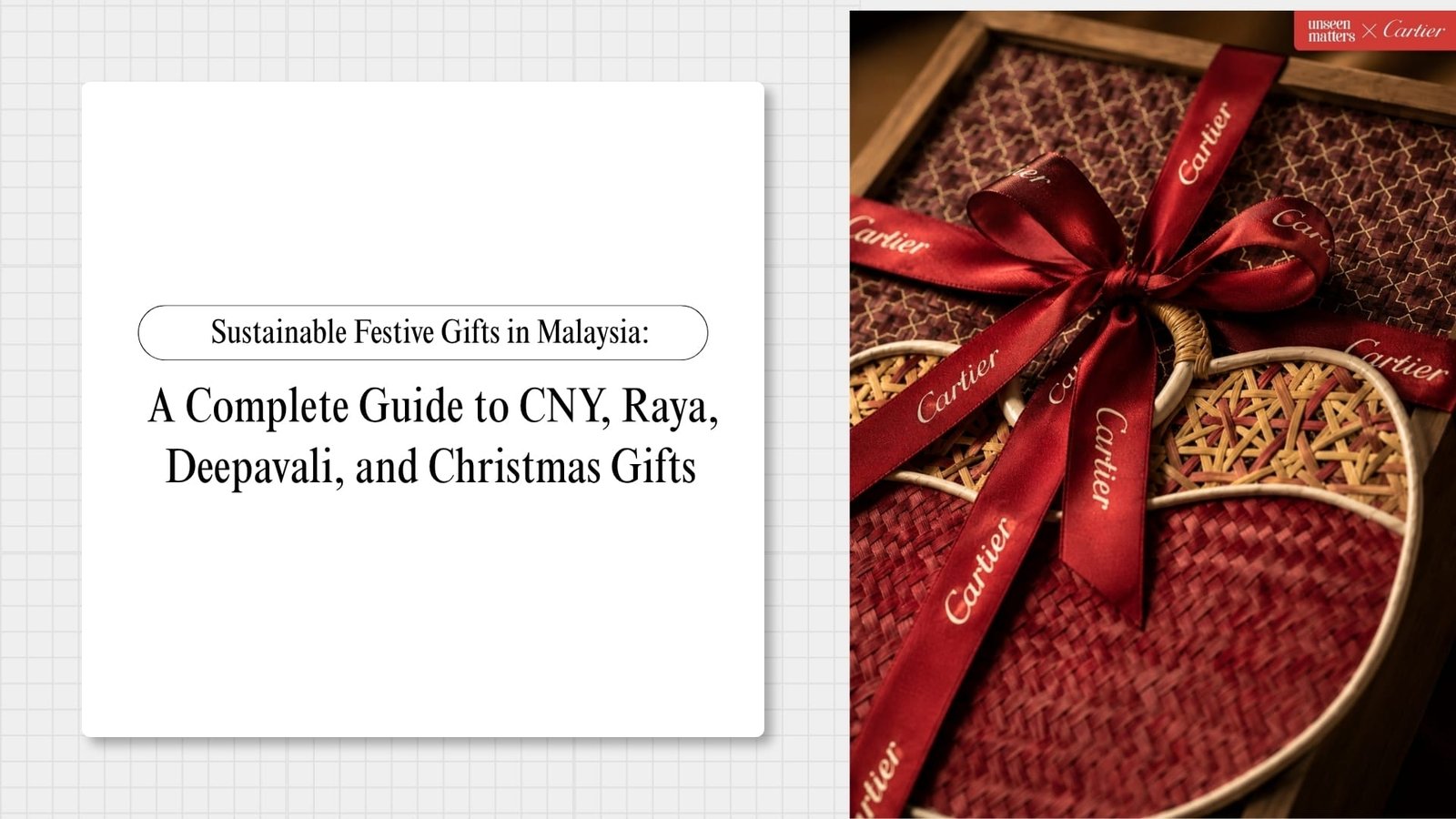
We’ve supplied sustainable festive hampers for CNY, Raya and other campaigns run by brands including Clarins, Cartier, Herbalife and Cycle & Carriage.
For CNY 2026, Clarins ran a sustainable hamper campaign through Unseen Matters. Cartier’s Raya 2025 gifting and Herbalife’s Raya 2026 gifting followed a similar structure — client brief, sample approval, then a production run timed to clear before the festive date. Cycle & Carriage’s Raya 2024 order is another example of a returning automotive-sector client using sustainable materials for homecoming-season client gifting. These aren’t hypothetical use cases; they’re campaigns that ran on the same process outlined below.
What’s the process from brief to delivery?
Every order runs through four steps: brief, sample approval, production, and delivery — typically a four-to-six-week window before the festive date.
- Share your brief. Tell us the festival, headcount, and the impression you’re going for. We recommend materials and product types that match your budget and timeline.
- Approve a sample. We produce a physical sample with your logo and festive packaging applied before you commit to the full run — so there’s no surprise at delivery.
- Production run. Orders run between 100 and 500 pieces per design, matched exactly to your approved sample, timed to clear well before the festive date.
- Delivery. Shipped from our Kuala Lumpur base, with coverage across Malaysia (including Penang) and Singapore.
What’s the minimum order quantity for a sustainable festive gift?
The minimum order is 100 pieces per design, with most standard orders falling between 100 and 500 pieces.
This range is set by how the production runs are batched with suppliers — smaller runs are possible on a case-by-case basis, but 100 pieces is the baseline for custom branding and festive packaging to be cost-effective.
Can festive gifts be branded with our company logo or festive theme?
Yes — full customization is available, including logo engraving or printing and festive-themed packaging applied directly to the material.
Branding is applied to the material itself rather than sitting on top as a sticker or removable tag — logo engraving on wood, printing on stone paper, or packaging built around the festival being celebrated (CNY red-and-gold cues, Raya ketupat motifs, Deepavali diya themes, and so on).
Where do sustainable festive gifts get shipped in Malaysia and Singapore?
We’re based in Kuala Lumpur and ship domestically across Malaysia, including Penang, as well as cross-border to Singapore.
This coverage matters most for Raya and CNY homecoming gifting, where staff and clients are travelling across the peninsula and hampers need to arrive intact ahead of the celebration, not during it.
How early should a company order festive gifts before the celebration date?
Order at least four to six weeks ahead of CNY, Raya, Deepavali or Christmas — these are peak seasons and production slots fill up fast.
Because standard runs sit between 100 and 500 pieces and every order goes through a sample-approval step before production, leaving less than a month before the festive date usually means compromising on material choice, customization, or both.
Why work with a gifting studio instead of ordering off a catalogue?
A gifting studio curates materials and manages the full process from sample to delivery, rather than leaving a company to source, customize and ship separately.
Unseen Matters isn’t a factory — we’re a sustainable gifting studio that sources from vetted material suppliers, manages sampling and branding, and coordinates delivery timed to the festival. That means one point of contact instead of juggling a material supplier, a printer and a logistics provider separately during the busiest gifting season of the year.
Ready to plan a festive gift order? WhatsApp us or email bd@unseenmatters.com with your festival, headcount and material preference — free consultation, no obligation.
YOUR COMMENT